
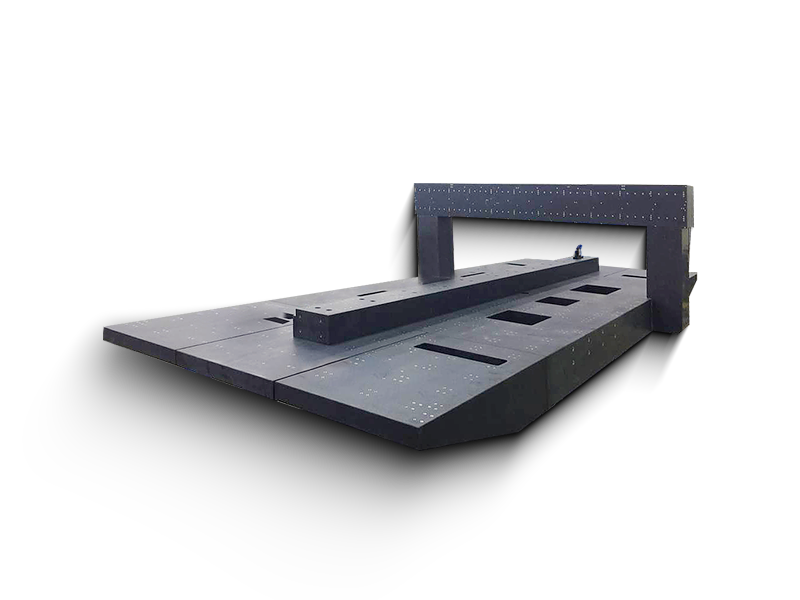
1. Precision Equipment Base Support Structures
Applications: Lithography machines, wafer inspection equipment, CMP (Chemical Mechanical Polishing) equipment, etc.
Functions:
- Vibration Damping Stability: Granite’s high damping properties absorb external vibrations and internal mechanical oscillations, ensuring stable operation at nanoscale precision.
- Thermal Stability: Its low thermal expansion coefficient (approximately 1/3 that of steel) maintains geometric stability under temperature fluctuations, preventing calibration failure due to thermal deformation.
- High Rigidity: Resists bending when supporting heavy components, ensuring long-term accuracy.
2. Lithography Machine Critical Components
Applications: Baseplates, guide rails, stages, and other components in EUV (Extreme Ultraviolet) lithography systems.
Functions:
- Ultra-Precise Positioning: Granite’s stability minimizes micro-motion errors, meeting the nanoscale positioning requirements of lithography machines (e.g., ASML systems).
- Environmental Resistance: Insensitivity to humidity and temperature variations makes it ideal for cleanroom environments.
- Hybrid Structures: Often combined with ceramics or composites to balance stiffness and lightweight demands.
3. Wafer Processing and Inspection Platforms
Applications: Worktables for wafer dicing, etching, thin-film deposition, and defect inspection equipment.
Functions:
- Flatness Retention: Granite’s naturally high flatness (achieving sub-micron levels through grinding) ensures uniform wafer support.
- Chemical Resistance: Withstands corrosive chemicals (acids, alkalis) used in processes, extending equipment lifespan.
- Anti-Static Treatment: Surface coatings prevent electrostatic adsorption of particles, avoiding wafer contamination.
4. High-Precision Measurement and Alignment Systems
Applications: Wafer alignment tools, reticle calibration devices, laser interferometer bases.
Functions:
- Long-Term Dimensional Stability: Minimal creep over time reduces recalibration frequency.
- Low Thermal Hysteresis: Rapid recovery after temperature changes ensures measurement repeatability.
5. Robotic Arms and Transfer Systems
Applications: Wafer-handling robots, automated transfer guide rails.
Functions:
- Wear Resistance: Maintains surface smoothness under prolonged high-frequency sliding friction.
- Lightweight Design: Uses porous granite or composite structures to reduce weight while preserving rigidity.
Advantages Summary
| Property | Value in Semiconductor Industry |
|---|---|
| High Rigidity & Damping | Suppresses vibrations, ensures nanoscale machining accuracy |
| Low Thermal Expansion (≈3×10⁻⁶/°C) | Stable dimensions under temperature fluctuations, minimizes thermal errors |
| Chemical Inertness | Resists corrosive process environments (e.g., etching, cleaning) |
| High Hardness (Mohs 6-7) | Wear-resistant, extends equipment lifespan |
| Insulation & Anti-Static | Prevents electrostatic damage to sensitive components |