
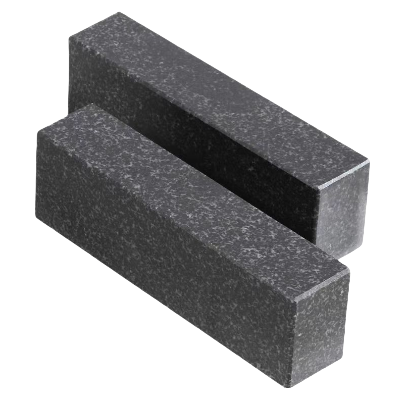
The Granite Parallel Gauge is a high-precision measurement tool made from natural granite, primarily used to inspect the flatness, parallelism, and dimensional accuracy of workpieces. Leveraging granite’s superior physical properties, it serves as an irreplaceable reference tool in precision machining, quality inspection, and scientific research.
I. Core Features
- Ultra-High Stability
- Formed over millions of years, granite has fully released internal stresses, virtually eliminating deformation risks.
- Extremely low thermal expansion coefficient, ensuring dimensional stability under temperature fluctuations.
- Exceptional Hardness & Wear Resistance
- Mohs hardness of 6–7, scratch-resistant surface with long-term accuracy loss below .
- Environmental Resistance
- Resistant to acids, alkalis, rust, and non-conductive, suitable for humid, oily, or electromagnetically sensitive environments.
- Natural damping properties absorb vibrations, minimizing measurement errors.
- Zero Magnetization Risk
- Non-metallic material avoids magnetic interference, ideal for precision electronic component inspection.
II. Manufacturing Process
- Material Selection & Pre-Treatment
- High-quality granite (e.g., Jinan Black, Indian Black) with uniform color and no cracks.
- Rough-cut to blank dimensions and stabilized for 48 hours to release residual stresses.
- Precision Grinding
- Rough Grinding: Diamond grinding wheels achieve initial flatness of 0.005.
- Semi-Fine Grinding: Epoxy resin grinding discs refine flatness to 0.001.
- Manual Precision Polishing: Diamond powder polishing achieves final flatness of ≤1.5 μm/m (Grade 000).
- Functional Machining
- Drill holes for metal dowel pins or threaded sleeves to enhance functionality.
- Surface polished to roughness Ra ≤0.1 μm, reducing friction.
- Accuracy Calibration
- Parallelism and flatness verified via laser interferometers.
- Rechecked after 24 hours in a controlled environment (20±1∘C).
III. Accuracy Grades & Specifications
| Grade | Parallelism Tolerance (μm) | Applications |
|---|---|---|
| 000 | ≤1.5 | Ultra-precision measurement (optical components, semiconductor wafers) |
| 00 | ≤3.0 | High-precision machine tool calibration, CMM reference |
| 0 | ≤6.0 | Routine industrial inspection, mold testing |
Compliant with GB/T 20428-2006 “Rock Surface Plates” and ISO 8512-2:2010.
IV. Key Applications
- Machining Inspection
- Verify parallelism between CNC machine tables and spindles.
- Inspect assembly accuracy of gearboxes, engine blocks, etc.
- Precision Instrument Calibration
- Serve as reference gauges for Coordinate Measuring Machines (CMM).
- Calibrate horizontality of laser interferometers and optical platforms.
- Electronics & Semiconductor Industry
- Parallelism checks for silicon wafer cutting equipment.
- Reference alignment for lithography machine masks.
- Scientific Research
- Installation benchmarks for high-energy physics experiments.
- Parallel alignment of precision optical components.
V. Usage & Maintenance Guidelines
- Operating Protocols
- Handle gently to avoid impacts; clean surfaces with anhydrous ethanol before use.
- Ensure contact surfaces are free of contaminants during measurement.
- Environmental Requirements
- Controlled temperature , humidity 40–60% RH.
- Isolate from vibrations; use air-floated anti-vibration platforms.
- Routine Maintenance
- Clean regularly with neutral detergents; avoid acidic solvents.
- Recheck accuracy with laser interferometers every 6 months; regrind if deviations exceed limits.
- Storage Conditions
- Store vertically on dedicated wooden racks or horizontally under dust covers.
- Avoid stacking to prevent deformation.
VI. Advantages Over Metal Parallel Gauges
| Criteria | Granite Parallel Gauge | Metal (Steel) Parallel Gauge |
|---|---|---|
| Thermal Stability | Negligible thermal deformation | Susceptible to thermal distortion |
| Maintenance Cost | Maintenance-free for life | Requires frequent oiling and rust prevention |
| Lifespan | 30+ years | 10–15 years (surface wear-prone) |
| Magnetic Interference | Fully non-magnetic | Risk of magnetization affecting precision |
VII. Selection Recommendations
- Accuracy Matching: Prioritize Grade 000 for semiconductor applications.
- Size Compatibility: Gauge length should cover 1.2–1.5 times the measured area.
- Functional Extensions: Opt for models with threaded holes or T-slots for sensor/fixture integration.
With its inherent advantages, the granite parallel gauge stands as a cornerstone tool in high-precision manufacturing and inspection. Proper use and maintenance ensure enhanced production yield and product consistency.
TYPE (mm) | flatness of working surface and parallelism between opposite surfaces | squareness between working surfaces | Height and width differences between a matched pair | |||
Precision Grade(μm) | ||||||
00 | 0 | 00 | 0 | 00 | 0 | |
160*25*16 | 1.5 | 3 | 20 | 40 | 1.5 | 3 |
250*40*25 | 2 | 4 | 30 | 60 | 2 | 4 |
400*63*40 | 4 | 8 | 40 | 80 | 4 | 8 |
450*75*40 | 4.5 | 9 | 45 | 90 | 4.5 | 9 |
630*100*63 | 6 | 12 | 50 | 100 | 6 | 12 |